







A few months ago, a colleague at Wirecutter sent me a TikTok video about Lola. This faux fur blanket went viral online and even earned its own nickname. The company claims its 100% synthetic fiber blanket is “the softest blanket on the market.” Each one retails for around $300.
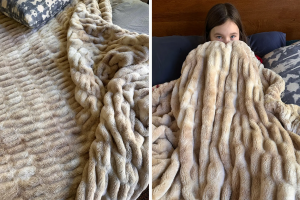
The price tag was staggering, especially considering its primary material is polyester. I’m always skeptical of products heavily promoted by influencers, and this blanket fit that description perfectly. (The company even participated in the recent New York Fashion Week, where models walked the runway cradling Lola blankets like oversized baby blankets.) In other words, I was skeptical from the start.
Nevertheless, the company’s hype and the blanket’s apparent flood of glowing reviews piqued my interest. I decided to test the large Lola blanket (60 x 72 inches) with the help of my two comfort-seeking kids and the expertise of writer Jackie Reeve. Jackie Reeve has been testing plush, cozy blankets and throws for Wirecutter for nearly nine years.
After testing the large Lola blanket at home for nearly three months, I found the kids absolutely loved it. (It’s worth noting that the blanket wasn’t purchased for the kids.) While we can’t claim it’s the softest blanket on the market, the Lola blanket delivers unexpectedly cozy comfort. In a market flooded with faux fur and microfiber blankets, the Lola stands out for its structure and density. However, we remain hesitant about its price, especially since we’re still unsure about its durability.
Ultimately, while the Lola Blanket is incredibly soft, we wouldn’t buy it at full price.
But it comes at a hefty price.
As of the time of writing, the large size of the Lola blanket retails for around $300, measuring 60 inches by 72 inches, which is large enough for two adults to curl up under (or, as is common in my household, a mother with one or two children). Considering that you can get other equally high-quality wool blankets for a fraction of the price of a Lola blanket, as Jackie pointed out to me (the LLBean wool blanket mentioned in our guide is a good example), this price is indeed quite high.
Despite the eye-watering price, Jackie concedes that considering the cost of the high GSM microfiber fabric and the blanket’s double-sided design, the Lola blanket’s pricing “doesn’t sound too outrageous”. Although the Lola blanket is positioned in the high-end of microfiber blankets, its price is not much different from that of faux fur brands like RH and West Elm, and is even comparable to that of Minky Couture, Lola’s most direct competitor, which was founded in 2009 compared to Lola’s establishment in 2021.
This blanket has the Oeko-Tex Standard 100 certification – a voluntary independent certification that tests for a wide range of chemicals including formaldehyde, bisphenol A and perfluoroalkyl substances – which may also lead to its higher price. (In addition, the company vigorously promotes this polyester blanket as “vegan” and “cruelty-free”, but in the context of environmental protection, these claims seem somewhat hypocritical.)
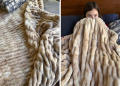
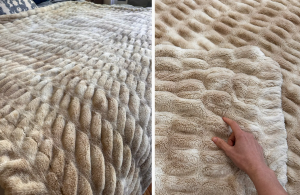
A close look at a beige Lola blanket reveals that it is divided into two sections. The blanket is thick and has a wavy texture. On the right side of the blanket, there are faint marks where someone has gently pressed their fingers.
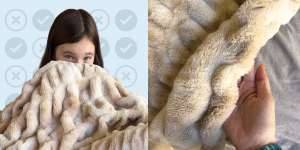 Left image: The Lola blanket fully spread out is almost as wide as my king-sized bed before washing and drying. Right image: After washing and drying, the fabric has not shrunk and remains soft, but it has lost some of its silky feel.
Although its price seems surprisingly reasonable compared to other faux fur blankets, Jackie said, “It’s hard to accept spending $300 on a polyester blanket. After all, you can get a very nice wool blanket or a high-quality cotton blanket for less money.” In Jackie’s blanket tests, natural fiber fabrics often look better than synthetic ones (including faux fur) after years of washing and daily use. Moreover, they do not release microplastics into the environment over time like artificial fur does.
We have no confidence in its durability. One of the ways I test the quality of the Lola blanket is by washing it at home. After all, spending hundreds of dollars on a blanket, of course, you hope it can last longer. And artificial fur, which is a plastic product, is notoriously delicate, prone to pilling, deformation, and even losing its softness after washing or dry cleaning.
I washed the blanket in cold water on a gentle cycle as per the company’s cleaning instructions. The company suggested letting it air dry naturally and not using a dryer, but it was really hard to find a suitable place at home to lay out a 5-foot by 6-foot wet blanket for several hours (or more likely, days). So, I used the dryer’s function (the company also recommended this method). To my surprise, after seven drying cycles, the Lola blanket finally regained its fluffiness, and there were only a few strands of fluff in the dryer’s lint trap.
The results were mixed. Although there were no obvious clumps or fiber damage after washing the blanket, it didn’t feel as silky smooth as before. The difference was even more pronounced when I compared the washed Lola blanket with a brand new one, which remained as soft as silk. The washed blanket also had a faint smell of plastic burning, which might at least partly be due to my husband mistakenly setting the dryer to the lowest temperature for one of the cycles (he doesn’t understand the drying rules!). 。
One hand was placed on the left half of the soft and textured Lola blanket, contrasting with the fluffy right side. The left side was smooth, while the right side was more puffy.
After washing the Lola blanket, I compared it (right) with a brand new blanket of a different color (left). The silky soft texture of the blanket had changed, and its fluffiness had decreased. It felt a bit like the fur of a teddy bear. Ivy Elrod / The New York Times Wirecutter
The performance of the Lola blanket after its first wash was better than I expected for a faux fur blanket. However, since it lost some of its silkiness, I am not too willing to machine wash and dry it frequently. Although I think if only spot cleaning is done, this blanket can probably maintain a good condition for about a year, after about three months of use, I am still a bit worried about whether its signature softness can be maintained in the long term.
We only buy when there’s a half-price promotion. If you want to temporarily relieve the anxiety of life and long for the feeling of being hugged and wrapped up, the Lola blanket might satisfy you – although it may not relieve your financial pressure. It’s like a pricey cloud of oil, but I can understand why people love it so much. Meanwhile, you can also get other comfortable and soft blankets for less money, or purchase a high-quality wool blanket that can be passed down through generations at a similar price.
Ultimately, although my kids love the undeniable softness of the Lola blanket, I definitely wouldn’t buy it at full price myself – but if there’s a buy one get one free promotion, I might not hesitate to get it, as this company seems to have such offers quite often. While this blanket might be worth the price for some people, my budget cap is $150. However, it’s still much cheaper than peeling off the skins of 50 Jellycat stuffed toys.